 JEONBUK NATIONAL UNIVERSITY
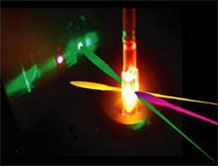
A lot of useful information could be obtained from the study on the interaction of UV-visible light with organic compounds. Major research topic during a span of 20 years (1985 - 2005) was focused on the photochemical transformation of organic compounds. Representative results include photochemical transformation of benzils to xanthones, photochemical formation of quinones from anthracenes, titanium dioxide-mediated hydroxymethylation of phthalimide, etc. Since 2006, research topic has been changed to physical/organic photochemistry using multi-laser systems. We synthesized various types of compounds, such as donor-acceptor dyads containing benzophenone and phthalimide to realize recyclable systems driven by two-color two-laser excitation. In recent years, we have been interested in the synthesis of new dyads containing naphthalimide, pyromellitic diimide, and perylenediimide to find out new electron/charge transfer systems. Most of our recent research was performed by the aid of Professor Majima using research equipments in Osaka University.

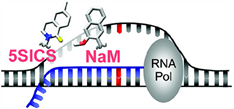
The main direction of my research will be focused on the new genetic alphabets. Nature is limited by the 61 codons that encode the 20 standard amino acids. Since the discovery of Watson-Crick base pairing, chemists and biologists have been fascinated by the idea of expanding the genetic alphabets as well as the genetic codes. The research of unnatural genetic code has been undertaken to overcome the coding limitations of natural bases (A, T, G, C). The research began with the use of complementary hydrogen bond, and has now moved to shape complementary. For almost two decades, many groups have developed several types of unnatural genetic alphabets with diverse design approaches:Hydrogen bonding and hydrophobic stacking property are the core elements nature has used to construct its DNA and RNA. In that point of view, to create entirely new genetic molecules, design approaches that rely only on hydrophobic complementary might have limitation: even though polymerases could incorporate these unnatural bases into a natural DNA template (i.e expansion), it may not be possible to build an unnatural-base-only DNA.
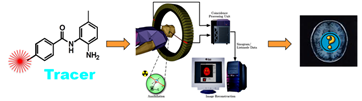
Epigenetics" refers to the study of changes that influence the phenotype without effecting alteration of the genotype. It involves changes in the properties of a cell that are inherited but do not entail a change in DNA sequence. "Epigenetics" impacts many areas of biomedicine like developmental biology, somatic gene therapy, cloning and genomic imprinting to name a few. It is now known that in addition to genetic defects, epigenetic defects can also cause disease. The field of "epigenetics" is gaining ground in importance in medicine as its knowledge base becomes a spark of inspiration to the discovery of new drugs. Furthermore, it is gaining importance as part of toxicology testing regiment during drug development. Despite the similarities in epigenetic processes across life, our understanding of the significance of epigenetic processes on the whole organism level remains very limited. My goal is to study the brain "epigenetics" in living organism to better understand its idiosyncratic properties in in-vivo systems. Small molecular drugs have been developed for targeting the "epigenetics" in in vitro, specifically with focus on the proteins like DNMT (DNA methyltransferase), HAT (Histon acetyltransferase) and HDAC (Histon deacetylase). However, even though it has been well documented at the in vitro level, there are still only limited numbers of tools available to study epigenetics targets and the processes which regulate "epigeneics" modifications on a whole organism level especially at the brain level.
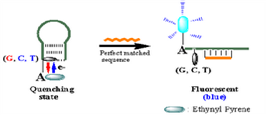
OrgRecently with advancing the biotechnology there are strong demand to produce a new functionalized bio material for using in the nano-bio technology and BioMEMS. First the application of this unnatural genetic alphabet and code would be the Nano-biotechnology such as DNA sequencing, SNP typing, DNA and RNA chip and Protein chip. Second this developed unnatural base pair could be used for the biophysical study of the biomaterials such as DNA, RNA, and Protein. In general site specific modification of biomaterial is a big barrier in biophysical study.